15 Best Screen-Free Activities for Kids — Fun Ideas Beyond Coloring
In a world of iPads, YouTube Kids, and endless streaming content, finding screen-free activities that genuinely engage children can feel like an uphill battle. But here's the truth: kids don't actually *need* screens to be entertained. They need creativity, movement, and connection.
Here are 15 proven screen-free activities that kids ages 2-12 will actually love — tested by parents and educators around the world.
Why Screen-Free Time Matters
The American Academy of Pediatrics recommends limiting screen time for children, and for good reason:
- Excessive screen time is linked to sleep disruption, attention problems, and reduced physical activity
- Creative play builds problem-solving skills that passive screen consumption cannot
- Hands-on activities develop fine motor skills essential for writing and daily tasks
- Face-to-face interaction during activities builds emotional intelligence and social skills
This doesn't mean screens are evil — but balance is essential. These activities provide that balance.
1. Printable Coloring Pages
Ages: 2-12 | Time: 15-60 min | Cost: Free
Coloring remains one of the most accessible and beneficial screen-free activities. It develops fine motor skills, teaches color theory, and provides a calming, meditative experience.
What makes it special: Unlike many activities, coloring requires minimal supervision, zero cleanup (if you stick to colored pencils), and can be done anywhere — at home, in restaurants, during travel.
Pro tip: Use our AI Coloring Page Generator to create custom pages based on your child's current interests. Obsessed with dinosaurs? Generate dinosaur pages. Love unicorns? Unicorn pages in seconds.
Browse our 250+ free coloring pages to get started.
2. Building Forts and Dens
Ages: 3-10 | Time: 30-90 min | Cost: Free
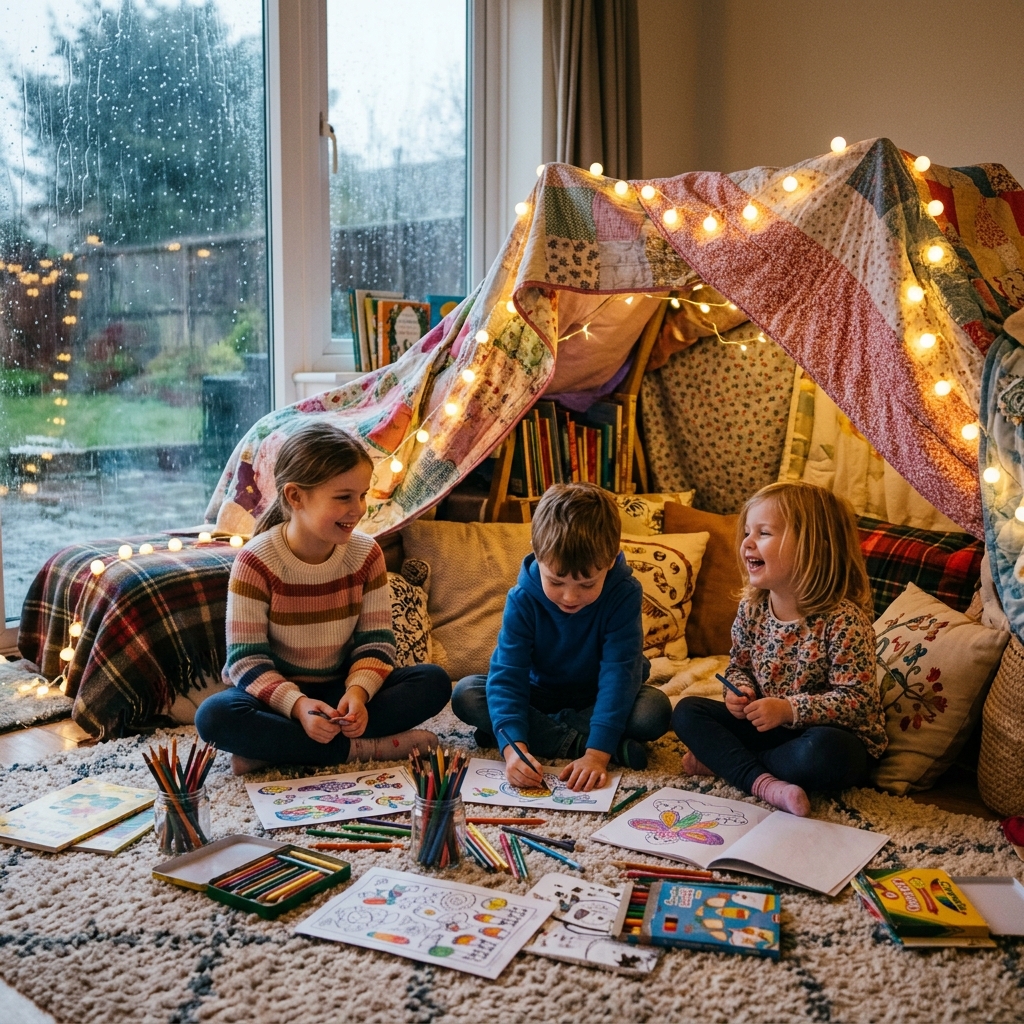
Blankets, pillows, chairs, and clothespins — that's all you need for an epic fort. This activity combines engineering thinking (how to make it stable), creativity (decorating and theming), and imaginative play (what happens inside the fort).
Take it further: Once the fort is built, bring in coloring pages, books, or a flashlight for shadow puppets.
3. Kitchen Science Experiments
Ages: 4-12 | Time: 20-45 min | Cost: Minimal
Using everyday kitchen ingredients, you can create erupting volcanoes (baking soda + vinegar), invisible ink (lemon juice), color-changing potions (red cabbage water), and slime (glue + borax).
These experiments teach cause and effect, chemical reactions, and the scientific method — all while feeling like pure fun.
4. Nature Scavenger Hunts
Ages: 3-10 | Time: 30-60 min | Cost: Free
Create a checklist of natural items to find: a feather, a smooth rock, three different leaf shapes, something red, something that smells good. Kids explore their environment with purpose and curiosity.
Bonus: Bring found items home and use them for art projects or nature journals.
5. Storytelling and Story Creation
Ages: 4-12 | Time: 20-40 min | Cost: Free
Take turns adding to a story, one sentence at a time. Or give kids a set of random objects and ask them to create a story connecting all of them. This builds vocabulary, narrative thinking, and creative confidence.
Writing variation: Older kids can write and illustrate their own short stories or comic books.
6. DIY Art Projects
Ages: 3-12 | Time: 30-60 min | Cost: Low
From paper plate masks to toilet roll crafts, DIY projects turn everyday items into art. Popular ideas include:
- Handprint animals
- Paper bag puppets
- Collages from magazine clippings
- Origami (paper folding)
- Friendship bracelets
7. Board Games and Card Games
Ages: 4-12 | Time: 20-60 min | Cost: Varies
Classic games like Uno, Connect Four, Jenga, and Candy Land teach turn-taking, strategic thinking, counting, and good sportsmanship. For younger kids, simple matching games work wonderfully.
8. Outdoor Play and Sports
Ages: 2-12 | Time: 30-120 min | Cost: Free
Sometimes the simplest solution is the best. Running, climbing, jumping rope, riding bikes, playing catch, or simply exploring the backyard. Physical activity is crucial for children's development and naturally limits screen time.
9. Cooking and Baking Together
Ages: 3-12 | Time: 30-90 min | Cost: Low
Following a recipe teaches reading, math (measuring), sequencing, and patience. Plus, kids eat what they make! Start with no-bake recipes for younger children and progress to supervised baking for older kids.
Simple starter recipes: fruit salad, sandwiches, smoothies, cookies, pizza from scratch.
10. Music and Dance Parties
Ages: 2-12 | Time: 15-45 min | Cost: Free
Put on some music and dance! Or make instruments from household items — rice in a container becomes a shaker, pots become drums, rubber bands on a box become a guitar. This develops rhythm, coordination, and pure joy.
11. Gardening
Ages: 3-12 | Time: 20-60 min | Cost: Low
Even without a garden, kids can grow herbs in cups on a windowsill. Gardening teaches responsibility, patience, biology, and the satisfaction of nurturing something to life.
Fast-growing options for impatient kids: cress (7 days), sunflowers (2 weeks to sprout), beans (1 week).
12. Puzzles
Ages: 3-12 | Time: 15-60 min | Cost: Low
Jigsaw puzzles develop spatial awareness, problem-solving, and patience. Choose age-appropriate piece counts: 12-24 pieces for ages 3-4, 50-100 for ages 5-7, 200+ for ages 8-12.
13. Reading and Library Visits
Ages: All | Time: 15-60 min | Cost: Free
Regular library visits make reading feel like an event rather than a chore. Let kids choose their own books. For reluctant readers, try graphic novels, joke books, or books about their favorite topics.
14. Playdough and Clay
Ages: 2-8 | Time: 20-45 min | Cost: Low
Squishing, rolling, cutting, and sculpting develops hand strength and creativity. Make playdough at home with flour, salt, water, and food coloring — it's cheaper and you can make any color!
15. Letter Writing and Pen Pals
Ages: 6-12 | Time: 20-30 min | Cost: Minimal
In the age of texting, receiving a handwritten letter is magical. Kids can write to grandparents, friends, or join a pen pal program. This improves handwriting, composition skills, and teaches thoughtfulness.
Creating a Screen-Free Routine
The key to reducing screen time isn't banning screens — it's replacing screen time with something better. Here's a simple framework:
- Start small — Replace one 30-minute screen session per day
- Prepare materials — Have coloring pages, craft supplies, and games easily accessible
- Join in — Kids are more likely to engage when parents participate
- Rotate activities — Keep it fresh by alternating between different options
- Be patient — The first few days may involve complaints, but kids adapt quickly
Free Resources to Get Started
- 250+ Free Coloring Pages — Print and color instantly
- AI Coloring Page Generator — Create custom pages from any description
- Rainy Day Coloring Activities — 15 creative coloring games
Remember: the goal isn't perfection. Every minute spent on creative, screen-free activities is a win. Happy playing! 🎨
Written by Sarah Chen
Sarah is an art education specialist and the founder of ColorJoy Prints. With a background in child development and over 5 years of experience in educational content, she creates evidence-based resources that make learning fun through creative activities.